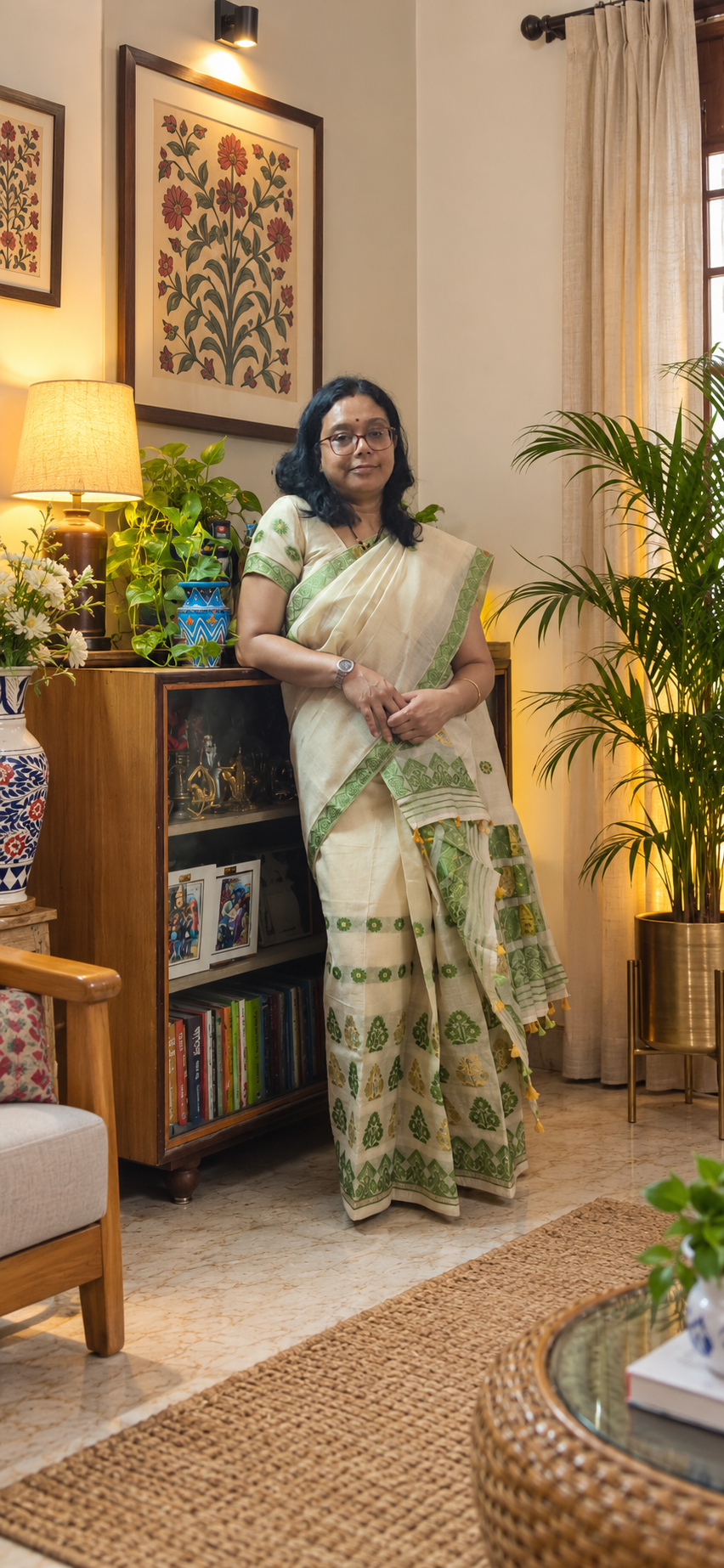
There Was No Single Moment.
There was no grandmother sitting by a lamp. No childhood memory of a loom. No dramatic revelation. Just years of living in the Northeast — breathing its air, walking through its markets, watching its festivals — and slowly, quietly, noticing something.
The motifs were disappearing. Not all at once. Not dramatically. Just gently fading, the way old photographs do when left in the sun too long. The Kingkhap, the Bisoni Gai, the intricate geometric patterns that women had woven into silk for centuries — they were still there, technically. But they were shrinking. Retreating to festival days, to museum shelves, to the backs of folded sarees in mothers' wardrobes.
And one day, the question would not go away anymore: If not now, then when? If not us, then who?
The Observation That Changed Everything.
The thing about traditional motifs is that they were never meant to be rare. They were not created for museums or for festivals or for once-a-year occasions. They were the everyday language of the people who made them. Woven into the fabric of daily life — literally.
A woman in 17th-century Assam did not save her Kingkhap-patterned Mekhela Sador for special occasions. She wore it. She worked in it. She moved through the world in it. The motif was not decorative. It was identity.
Somewhere between then and now, the story got complicated. Fast fashion arrived. Global aesthetics spread. The Northeast — already at the margins of the national imagination — found its traditional crafts squeezed further toward the edges. Not gone, but fading. Not dead, but not quite alive in the way they once were.
What HoopLocal Is, and Is Not.
HoopLocal is not a fashion brand. It is not about trends, or seasonal collections, or what is selling this quarter. It is a conversation between the past and the present — stitched into fabric you can wear on a Tuesday morning.
Every motif that goes onto a HoopLocal piece is researched first. We go to the source: archives, artisans, museums, community elders, weavers who still remember. We document the origin of the pattern, the community it belongs to, the meaning it carries. And then — only then — does it go on fabric.
The result is something different from what you usually find. Not a print that vaguely resembles a traditional pattern. Not an appropriation dressed up as appreciation. An actual motif, with its actual story, worn by someone who knows what they are carrying.
Why Embroidery.
We chose precision computerized embroidery for a specific reason: accuracy. Embroidery allows us to translate the geometry of a traditional motif — the exact angles, the exact spacing, the deliberate repetitions — onto a modern garment without losing what makes it meaningful.
Every stitch is intentional. Every thread is placed where it belongs. There is no sloppiness here, because there cannot be. When you embroider a royal Ahom motif onto a waistcoat, you owe it the respect of getting it right.
The fabric matters too. We work with Ahimsa Silk — silk harvested only after the silkworm has naturally completed its cycle and the moth has left the cocoon. Not cruelty-free in a vague marketing sense, but genuinely, traceable non-violent. Because what is the point of a brand rooted in cultural integrity if it cuts corners on its materials?
The New Tribe.
HoopLocal exists because we believe in a certain kind of person. Someone who is rooted and modern at the same time. Someone who wants their clothes to mean something — not just look good on Instagram, but actually carry something real. Someone who is proud of where they come from and unafraid to show it, not just on Bihu, not just at festivals, but every single day.
Fifteen thousand customers later, we know we were right about that person. They exist. They are everywhere. They are engineers and artists and teachers and entrepreneurs. They are from Guwahati and Delhi and Bengaluru and London and New York. They are the children of the Northeast who left, and the ones who stayed. They are people from outside the region who look at a HoopLocal piece and feel something they cannot quite name — because what they are feeling is the weight of a real story.
That is what we make. Not fashion. Not products. Stories, stitched into things you reach for every day.

Anindita Debroy Kalita
Founder, HoopLocal · Guwahati, Assam
Founded HoopLocal to bring the disappearing textile motifs of Northeast India back to everyday life — researched, documented, credited, worn with pride.
Based in Guwahati, Assam.